Two buildings. One museum.
Check out the schedule
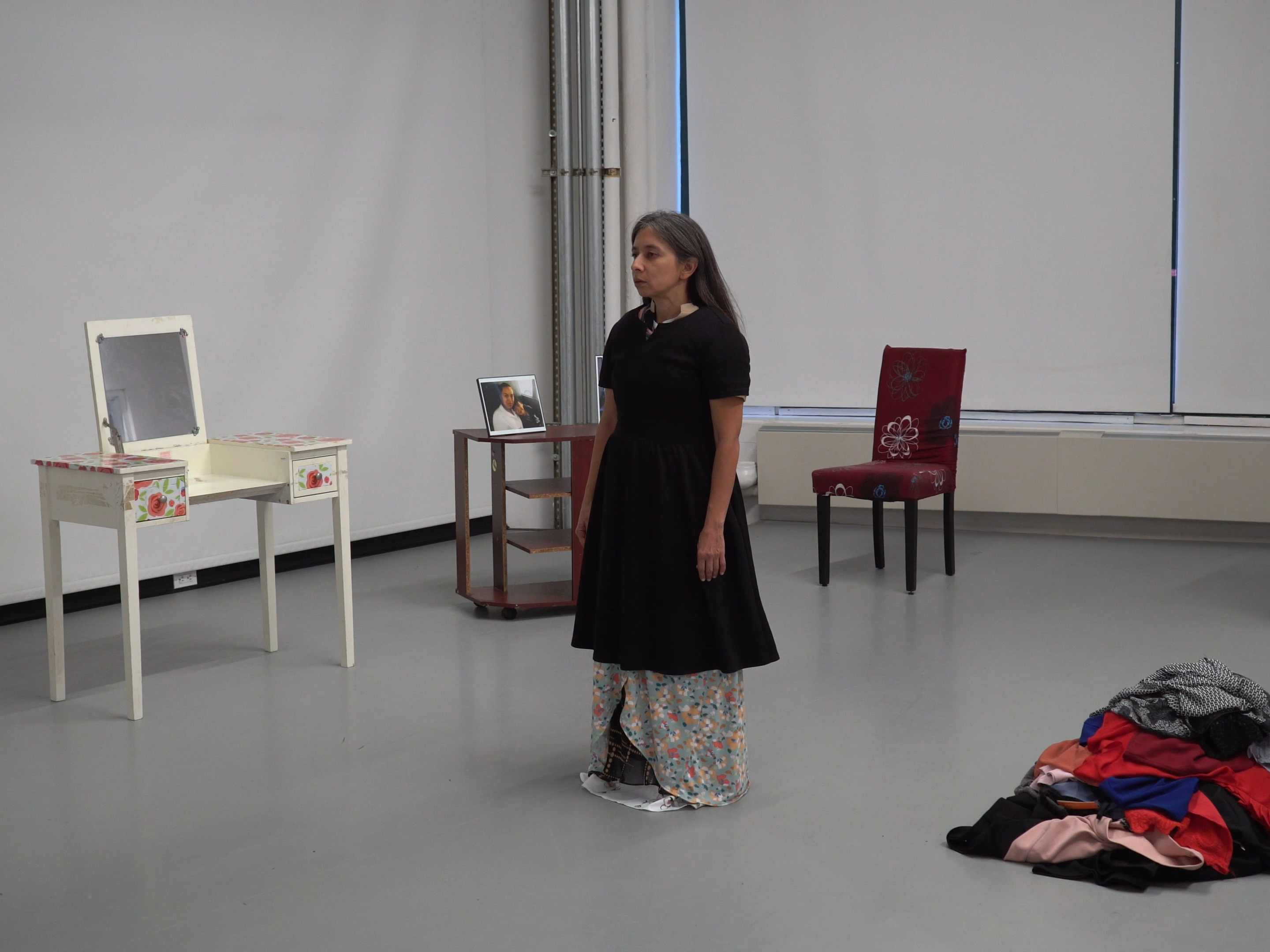
Regina José Galindo (Guatemala City, 1974) is an artist and poet who uses her own body to expose the violence imposed by power structures in contemporary societies. Born during the Guatemalan Civil War (1954–96), a conflict that decimated and caused the disappearance of thousands of Guatemalans, the artist’s work is deeply shaped by the political and ethical concerns stemming from this historical context. A pioneer of performance art in Latin America, her work pushes the physical limits of her own body and the audience to denounce human rights abuses and gender inequality.
In the video Deportada (Todo lo que perdí) [Everything I Lost] (2024), Galindo stands motionless amidst the personal belongings of Cristina Cazales Pacheco, a Mexican woman deported from New York back to her home country. Dressed in multiple layers of clothing that belonged to Cristina, the artist has these pieces gradually removed from her body by the public—a process that highlights the erasure of her existence by a society that normalizes the consequences of forced displacement, or even participates in this physical and symbolic dispossession. On a second channel, Cristina narrates her story and the anguish caused by the imposition of a border between her, her family, and her desires. Galindo has addressed Latin American immigration to the United States in previous works, and in this recent piece, she highlights the persistence and urgency of the violence that permeates the issue, reinforcing the importance of ensuring a face, a voice, and a presence for its victims.
Video Room: Regina José Galindo is curated by Bruna Fernanda, curatorial assistant, MASP.
The exhibition is part of the year dedicated to Latin American Histories, which also includes solo exhibitions by Carolina Caycedo, Claudia Alarcón & Silät, Colectivo Acciones de Arte, Damián Ortega, Jesús Soto, La Chola Poblete, Manuel Herreros de Lemos and Mateo Manaure Arilla, Pablo Delano, Rosa Elena Curruchich, Sandra Gamarra Heshiki, Santiago Yahuarcani, and Sol Calero, as well as the group exhibition Latin American Histories, and Video Room exhibitions by Clara Ianni, Claudia Martínez Garay, Edgar Calel, and Oscar Muñoz.
The walls of the Video Room: Regina José Galindo exhibition were painted with the colors Disco de Vinil Acrílico Fosco Decora Matte, Branco Neve Fosco Decora Matte, and Cinza Tecnológico Fosco Decora Matte by Tintas Coral, an AkzoNobel brand.

All temporary exhibitions at MASP feature accessibility resources, with free admission for people with disabilities and their companions. Tours in Libras (Brazilian Sign Language) or descriptive tours are available upon request via email at acessibilidade@masp.org.br; texts and captions are available in large print, and audiovisual content includes audio description, subtitles, and Libras interpretation. All materials are available on the museum's website and YouTube channel and can be used by people with or without disabilities, school groups, teachers, non-literate individuals, and anyone interested, whether during spontaneous visits or those accompanied by the MASP team.
Accessible tours
People with disabilities can request a guided tour with the MASP team.
Request via email: acessibilidade@masp.org.br.
Large-print booklets
The accessible booklets contain all exhibition texts and labels in large print, as well as information on gallery layouts, artwork placement, flow and circulation, and a brief description of the space. Physical copies are available for use during your visit, and a digital PDF version can be accessed via QR code. Screen readers can be used to listen to all the exhibition text content.