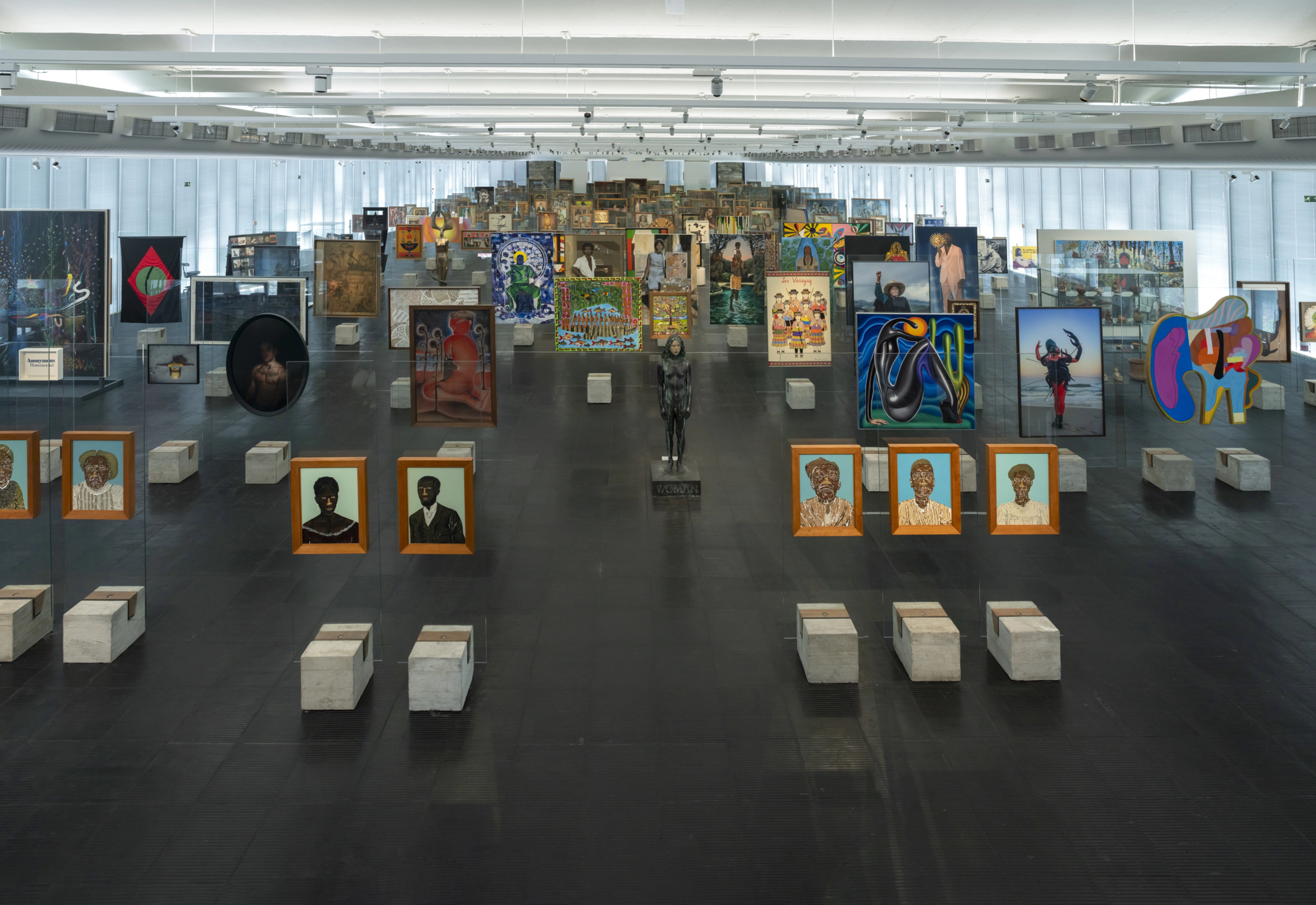
Collection in transformation is the title of the long-term exhibition of the MASP collection. The artworks are installed on crystal easels—glass panes fitted into concrete blocks—arranged in rows without partitions in the museum's spacious second-floor gallery. The open, fluid, and permeable space of the gallery offers multiple possibilities for access and interpretation, eliminating hierarchies and predetermined routes. Taking the paintings off the walls and placing them on the easels allows visitors to walk among them, as if in a forest of works that seem to be suspended in mid-air.
The crystal easels, designed by Lina Bo Bardi (1914-1992)—who also designed the MASP building—were introduced in 1968 for the inauguration of the museum's headquarters on Avenida Paulista. Replaced in 1996 by room-dividing walls, these displays were brought back in 2015. Since then, the exhibition has remained in constant flux, as its title suggests, with works entering and leaving due to loans, new acquisitions, and rotation. The labels for the artworks are placed on the back of the easels, as Lina Bo Bardi's original proposal was for the visitor's first encounter with the works to be direct, free from contextualization or information regarding authorship, title, and date.
Today, the works are organized chronologically, with the most recent in the front rows and the oldest in the back. However, this rigid chronology is sometimes broken by contemporary artists—such as the inclusion of works by Carla Zaccagnini, Sofia Borges, Dora Longo Bahia, and Waltercio Caldas—which allows for friction between different historical periods, or to articulate thematic dialogues, as seen in the row dedicated to landscapes.
One of the main acquisition criteria at MASP focuses on works that have been featured in museum exhibitions; therefore, there is a strong presence of works that were part of shows held during the cycles of Afro-Atlantic Histories, in 2018, Women's Histories, feminist histories, in 2019, and Brazilian Histories, in 2021-22. In this context, the first row is entirely dedicated to works by Black artists, while the second is dedicated to women artists, which advances MASP's mission as a diverse, inclusive, and plural museum. The iconic Guerrilla Girls poster, created in 2017 and displayed here, critiques the low representation of women that existed in the collection exhibition—a percentage that was 6% and is now over 20%. There is still much work to be done.